


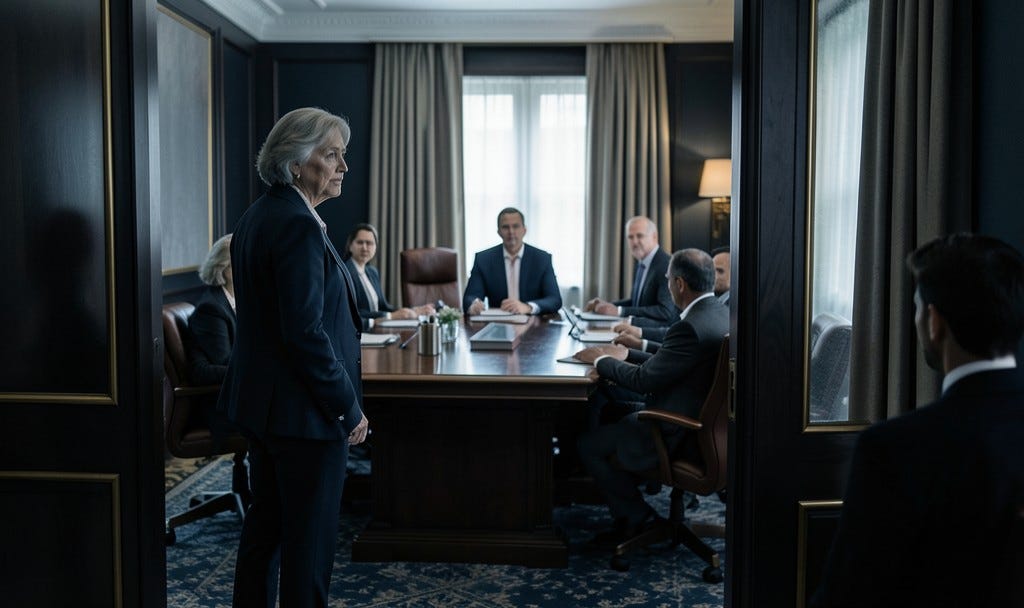
You walk into a room and know, immediately, that something is wrong. You don’t see anything obviously amiss., but something does not feel right. In fact, the tone is right, the words are fine and all looks well on the surface. But something doesn’t land. Your body tightens and your awareness heightens, and theres something quite uncomfortable. You leave earlier than planned because the pull has been greater than your logic. Later, you learn a conflict happened after you left but the buildup begn before you arrived—one no one mentioned it, not one person had the sense that something was wrong and the expectations were that you would be at the place you were meant to meet.
That knowing isn’t mysterious. It isn’t luck. It’s applied intuitive intelligence working in the background.
We live inside a strange contradiction. We’ve built entire institutions around the idea that real thinking happens in the analytical brain—the part that calculates, proves, defends each step. The part that can be audited. In fact, in most organizations, from government to corporate and from entrepreneur to author, we are educated that the brain is the foundation of all functions, feelings, and decisions. In my opinion, that is only scratching the surface, and there’s a missing signal.
Most of the time, most of us know things we can’t yet prove and science cannot be totally trusted when our experiences contradict the assumptions of science. We feel the flaw in the argument before we can name it. ‘Experience trumps theory’ We sense which person in the meeting isn’t being honest, but logically it makes no sense. Yet our lived experiences in the patterns we feel, see and hear tell us something more, and we need to learn how to discern.

I will share an example in my own life experience that exemplifies this premise. I walked into the boardroom; I was there in a consulting capacity to get a read on what could not be seen and to identify any weaknesses. All was well, just another meeting, another day and expectations ready to be voiced. Excitement reigned supreme along with slight trepidation from the other board members who were more cautious about the multi million dollar deal. I watched, recognized and discerned and pulled my colleague aside and told him something that floored him. One of the board, was plotting and another was being untruthful with his relationship with a member of the management staff, which was a danger to the board. Logically it made no sense, there was no external signal but within my experience, the pattern screamed something different. My colleague spoke to the CEO privately after the meeting. It was so unbelievable and was not taken seriously and was rejected as pure fantasy. Turned out, my signal and discernment was right and the underhanded dealings were found out almost too late after some damage already occurred. Suffice to say, I was then retained after that as an advisor.
For many of us, we understand what the company or a project actually needs, even though the stated requirements say something else, but too often we are too fearful to put that theory or hypothesis forward. In fact, I would venture to say, that if we followed other signals and discerned what was real and what may be noise, perhaps our leaders in power or those who consult for them would not fall into too many traps. Maybe those who worked in the shadows to keep us safe would not become the falling stars. Consequently, almost everything in how we’re taught, how we work, how we evaluate each other, tells us this knowing doesn’t count. Not really. Not until we can explain it. That is the true weakness in the craft.
The cost of this hierarchy is quietly enormous.
Consider a manager choosing between two candidates with similar credentials. One fits the resume perfectly. The other doesn’t, but something about their questions, their way of thinking about the problem, made the manager’s intuitive feelings flare. The manager has learned not to trust this and leans toward a learned instinct and not a discerned pattern. She goes with the resume. Two years later, she’s managing around the second candidate’s limitations, wishing she’d listened to the knowing she dismissed as a form of bias.
Or a founder who has worked in his industry for fifteen years. He sees a shift in how customers talk about the problem and the expectations. It’s subtle—nothing’s changed in the data yet. His board wants proof. They want a metric because that is the only thing they trust. They want him to wait. He waits. Eighteen months later, they’re scrambling to adapt to a market change everyone can now see coming. He saw it already. But he learned that seeing isn’t enough. The board blames him for not being ready or warning them and as well all know, that crap runs down hill.
“You already know things. The question is whether you’ll trust what you know enough to act on it…”

The intuitive intelligence - the pattern recognition, the felt sense, the knowing without explanation—is treated as the less sophisticated cousin of logical analysis. The problem is that intuition gets blamed for all our biases and blindspots because we want to fall on the side of logic. And yes, it does carry them to an extent. We absolutely have prejudices we mistake for insight and we often allow ego to drive our decisions or the linear pattern that we think is absolutely right. We feel that we have to project our fears onto situations and think we’re reading the room. That’s real, but its wrong and a room read in logic can be the fall of an operation.
So, what is the the solution? Well, it isn’t to banish intuitive knowing. It’s to understand what it actually is and to learn to discern the signal from the noise and only take what patterns in the noise suppor the signal.
Intuition isn’t a guess and its not a spiritual skill based on your psychic powers that only you think you have. It’s not a feeling floating free from evidence. It’s compressed human applied intelligence that goes beyond the brain. It’s your nervous system and your accumulated experience, running fast, pattern-matching at speeds your conscious mind can’t articulate in real time and its harnessing the power of your mind to discern the pattern. When you know a person is lying, you’re picking up micro signals—a change in breathing, a mismatch between words and face. When you sense a strategy won’t work, you’re drawing on everything you’ve seen fail or succeed before, all at once. Micro signals can also lie to you, and therefore moving beyond and discerning the overlapping pattern and the convergence allows you to become aware, detect, assess, discern and then act.
The issue is that this intelligence arrives without its receipts and you have to learn th cycle.
You can’t hand someone the proof because the proof is distributed across a myriad of moments in your past and your present. So we’ve decided, culturally, that if you can’t show your work, it doesn’t count as work. Analysis has the advantage that it can be checked. It can be debated, step by step. It can be blamed, audited, traced. Intuition just shows up and says “this is the pattern, and this is the true signal” and then it’s your reputation if you’re wrong. That’s why many individuals are scared to rely on that signal or knowing.
This makes intuition look riskier than it is. Because analytical reasoning fails too. It fails quieter, then we can trace exactly why we made a mistake, which feels more honest—but it fails. The difference is that analysis gives us a false sense of certainty. The steps feel solid. The logic feels proven. And yet the conclusion can still be completely wrong because the initial premises were incomplete, or the world doesn’t behave the way the model assumed and so the discerning between signal and noise is missing.
The best decision-makers don’t pit these against each other.
They use analysis to pressure-test intuition, not to override it, but to discern it. They cultivate the ability to notice what they know before they can explain it. They create environments where people can name their instincts—”I don’t think this works, and I can’t fully say why yet”—without being dismissed as unscientific.
They also stay skeptical. They don’t confuse their intuitions with truth. But they treat intuitions as real data, as signals worth investigating, not as noise to be eliminated.
What we’ve lost in prioritizing the provable is a certain kind of practical wisdom and we rely to heavily on the brain and misunderstand the power of the mind. The ability to move. To make choices in conditions of incomplete information, which is basically all the time, and to trust the intuitive intelligence you actually possess rather than waiting for certainty that won’t come. This is true power and it belongs to us all.
Intuitive knowing also keeps us grounded in what matters. A spreadsheet can tell you your company is on track. Your intuition tells you people are checked out, that the work doesn’t mean anything to them anymore. One is easier to defend. The other is true. Both matter.
The bias worth guarding against isn’t intuition itself. It’s the bias toward what you can prove, even when it’s incomplete. It’s the bias toward the measurable over the real. It’s the bias toward the explanation you can defend in a meeting over the knowing that might actually serve your organization.
Some of the most significant decisions you make—who to trust, what to pursue, when to abandon a path—won’t be made with enough information. You’ll never have complete data. You can’t run a long enough simulation. You have to decide. And you will decide, whether you acknowledge it or not, using the intelligence you already have.
The question is whether you’ll admit to using it.
The cost of pretending you’re purely analytical, of waiting for certainty that won’t come, of dismissing the knowing that has no explanation—that’s not intelligence. That’s abdication. It’s a way of delegating responsibility to the facts, so when things go wrong, you were just following the data.
You already know things. The question is whether you’ll trust what you know enough to act on it—carefully, skeptically, willing to be wrong, but not frozen by the impossibility of perfect proof.
That’s the intelligence worth paying attention to. There’s a vast chasm between what you know and what you think you know!
Thank you for reading Compass and Signal
JB